
Adlai vs. Rice
Nutrition, texture, water use, crop systems, and the agricultural logic behind both grains.
Quick comparison
Rice is one of the most efficient staple foods ever created. Adlai comes from a completely different agricultural rhythm. Both are naturally gluten-free. Both can anchor a daily meal. But they behave differently in the body, in the kitchen, and in the field.
| Nutrition | Adlai | White Rice | Brown Rice |
|---|---|---|---|
| Protein | High for a staple grain | Low | Moderate |
| Fiber | Naturally high | Very low | Moderate |
| Glycemic impact | Low and gradual | High, fast-digesting | Medium |
| Satiety | Deep and long-lasting | Light, short-lasting | Moderate |
| Micronutrients | Broad spectrum in intact grain | Reduced by milling | More retained |
| Gluten-free | Yes | Yes | Yes |
| In the Kitchen | Adlai | White Rice | Brown Rice |
|---|---|---|---|
| Typical cook time | 20–25 minutes | 12–15 minutes | 35–45 minutes |
| Texture | Structured, gently chewy | Soft and fluffy | Firm, slightly dense |
| Meal prep performance | Excellent — reheats and holds for days | Best fresh | Can harden when cold |
| Cooking forgiveness | Very forgiving | Narrow window | Needs soaking for best result |
| Crop System | Adlai | White Rice | Brown Rice |
|---|---|---|---|
| Growing system (typical) | Rain-fed upland fields | Flooded paddies | Flooded paddies |
| Water demand | Significantly lower in traditional systems | Very high | Very high |
| Methane emissions | Minimal in non-flooded cultivation | High in conventional systems | High in conventional systems |
| Breeding focus | Traditional slow-maturing grain | Yield & uniformity | Yield & uniformity |
| Crop diversity context | Typically part of diverse upland rotations | Often monoculture | Often monoculture |
What This Table Is Really Showing
White rice is optimized for speed. Brown rice is an intact version of the same system — more complete nutritionally, but still shaped by the same agricultural priorities.
Adlai comes from a different logic entirely. It’s not just a “low glycemic substitute” to rice.
Adlai grows slowly, in tropical rain-fed environments, without the pressure for rapid turnover. That slower cycle is the reason it develops more protein, more fiber, and a structure that holds on the plate and in the body.
This is not a question of one grain being “better” than another.
It is a question of what each grain was designed to do.
The numbers are useful, but the agricultural history behind them is the real story.
Two staple grains, two agricultural logics
Rice is one of the great achievements of agriculture. It feeds more than half the world, grows in an extraordinary range of climates, and has been refined for thousands of years to produce reliable yields. Any comparison with rice has to begin with that respect.
And yet, when you place a bowl of rice beside a bowl of adlai, you are looking at two grains shaped by entirely different priorities.
Thousands of years of selective breeding optimized for yield per hectare, fast harvest cycles, and reliable uniformity across industrial systems.
A traditional landrace grain shaped by local environments and farming communities rather than industrial breeding priorities.
Everything that follows — nutrition, texture, water use, soil impact, even how the grains feel in your body — begins in the field.
The difference begins with water
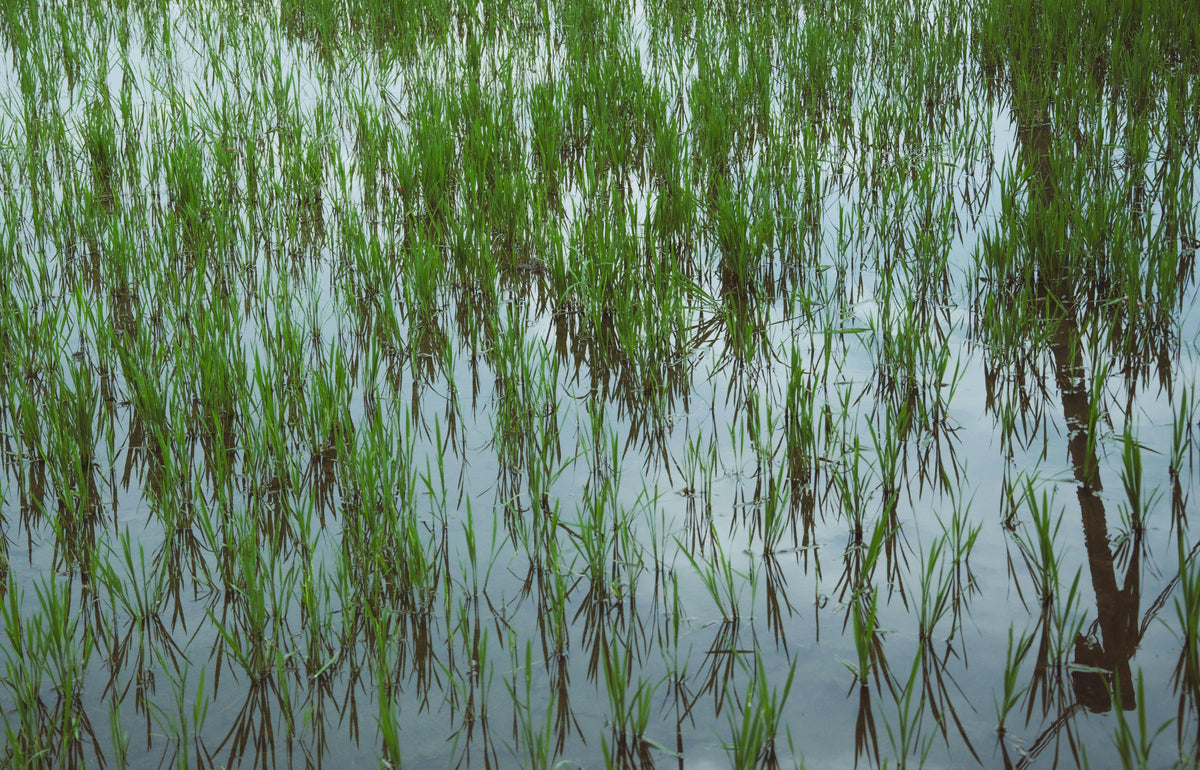
Most of the world's rice is grown in flooded paddies. That method is extraordinarily productive, but it is also one of the most water-intensive cropping systems on earth. Globally, rice cultivation consumes roughly a quarter of all freshwater used in agriculture.
Flooding also creates anaerobic soil conditions, and those conditions produce methane — one of the most potent greenhouse gases. Rice cultivation is responsible for about 30 percent of agricultural methane emissions and a significant share of total cropland greenhouse gases.
None of this makes rice "bad." It makes it a crop that succeeded in feeding billions under the constraints of the twentieth century. But it does mean that the system that made rice global is a high-input system.
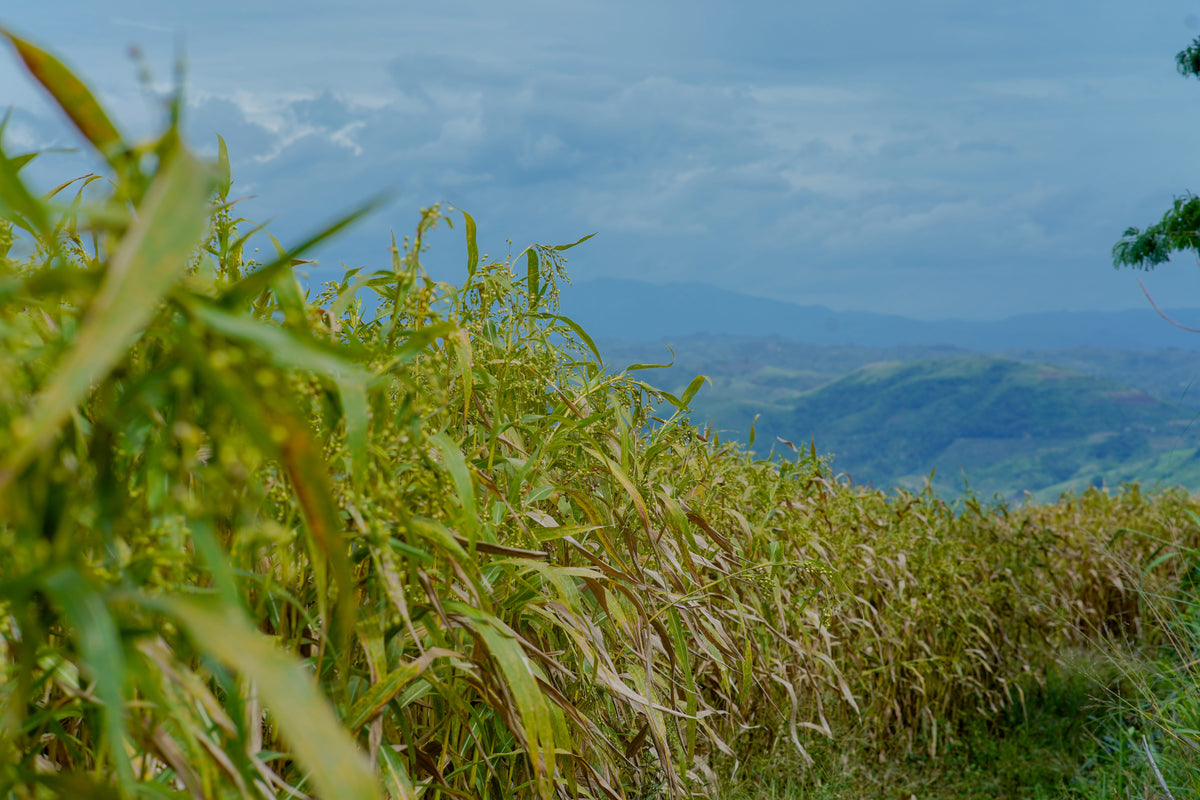
Adlai comes from a different agronomic context. It is traditionally grown in rain-fed upland environments without continuous flooding. The result is not just a different environmental footprint. It is a different kind of grain.
That changes the water demand, the microbial life in the soil, and the structure of the field itself.
Soil: annual monoculture vs. slow upland rotation
Modern rice systems are often monocultures that depend on repeated planting, external fertilizer inputs, and controlled irrigation. Over time, these systems can lead to soil nutrient depletion and reduced organic matter if they are not carefully managed — one of the central challenges of intensive grain agriculture worldwide.
Upland grain systems, including traditional adlai cultivation, are typically integrated into more diverse cropping patterns. They are rain-fed, less mechanically disturbed, and embedded in landscapes where soil structure is preserved rather than rebuilt each season.
his is not nostalgia. It is agronomy. It is also why the grain itself develops differently.
The genetics of yield
Rice is one of the most intensively bred crops on earth. High-yield varieties, hybrid systems, and — in some regions — genetically engineered lines have all been developed to increase productivity, tolerate drought or flooding, resist pests, and standardize harvests. There are even ongoing efforts to redesign rice at the photosynthetic level to push yields further.
That work is a scientific achievement. It also means that modern rice is a crop shaped by the logic of maximum output per hectare.
Adlai has not been bred for industrial uniformity. It remains closer to its traditional heritage grain form — a slower-maturing ancient grain that trades speed for completeness. And that trade shows up on the plate.
Nutrition and satiety
Rice, especially white rice, is primarily a fast-digesting carbohydrate. Adlai is a staple that carries significantly more protein, more fiber, and a slower glycemic response.
That slower digestion is not a dietary trend. It is a function of intact grain structure. You feel it as stable energy, lasting fullness, and a meal that does not require something else an hour later.
If you are new to the grain, the complete guide to what adlai isexplains why its growing cycle produces that nutritional difference.
Texture Is the Daily Reality
Data matters, but staples are defined by repetition.
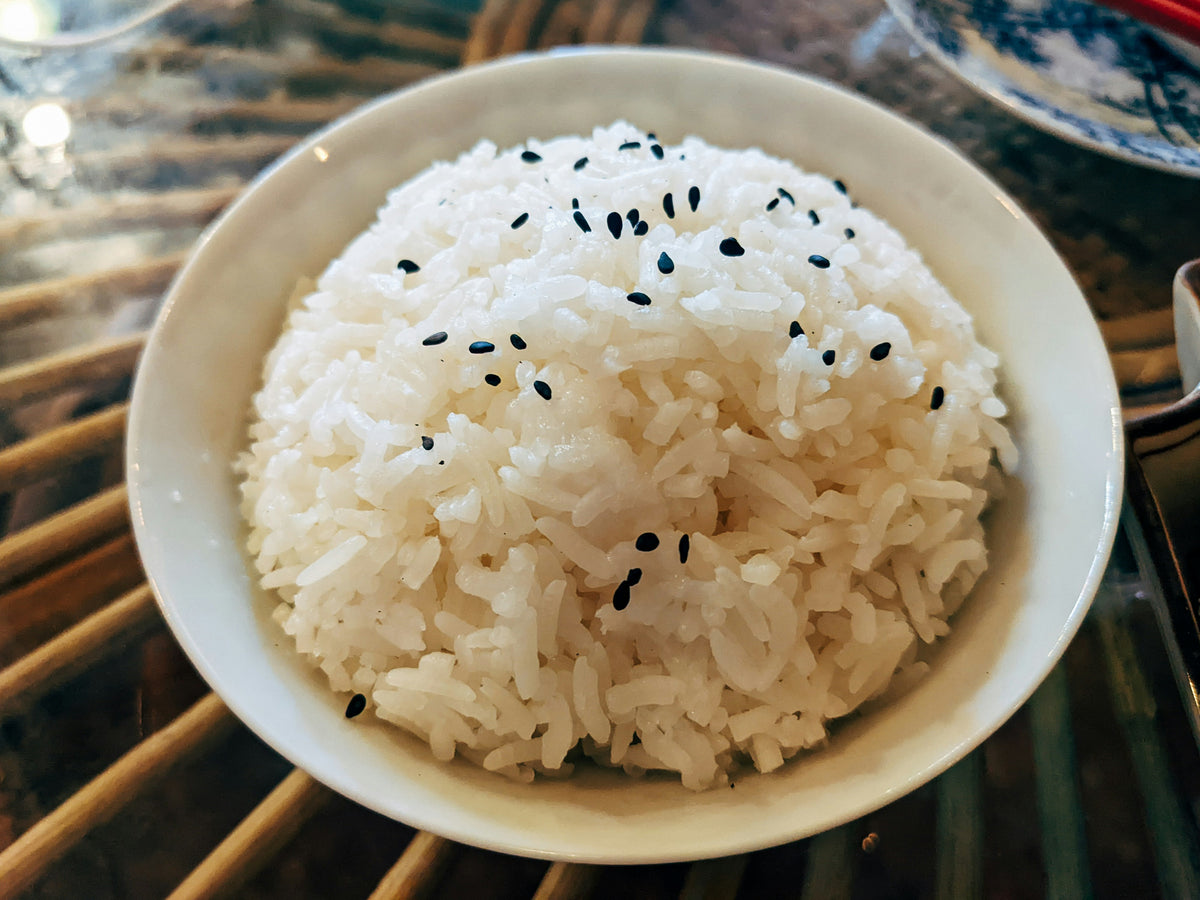
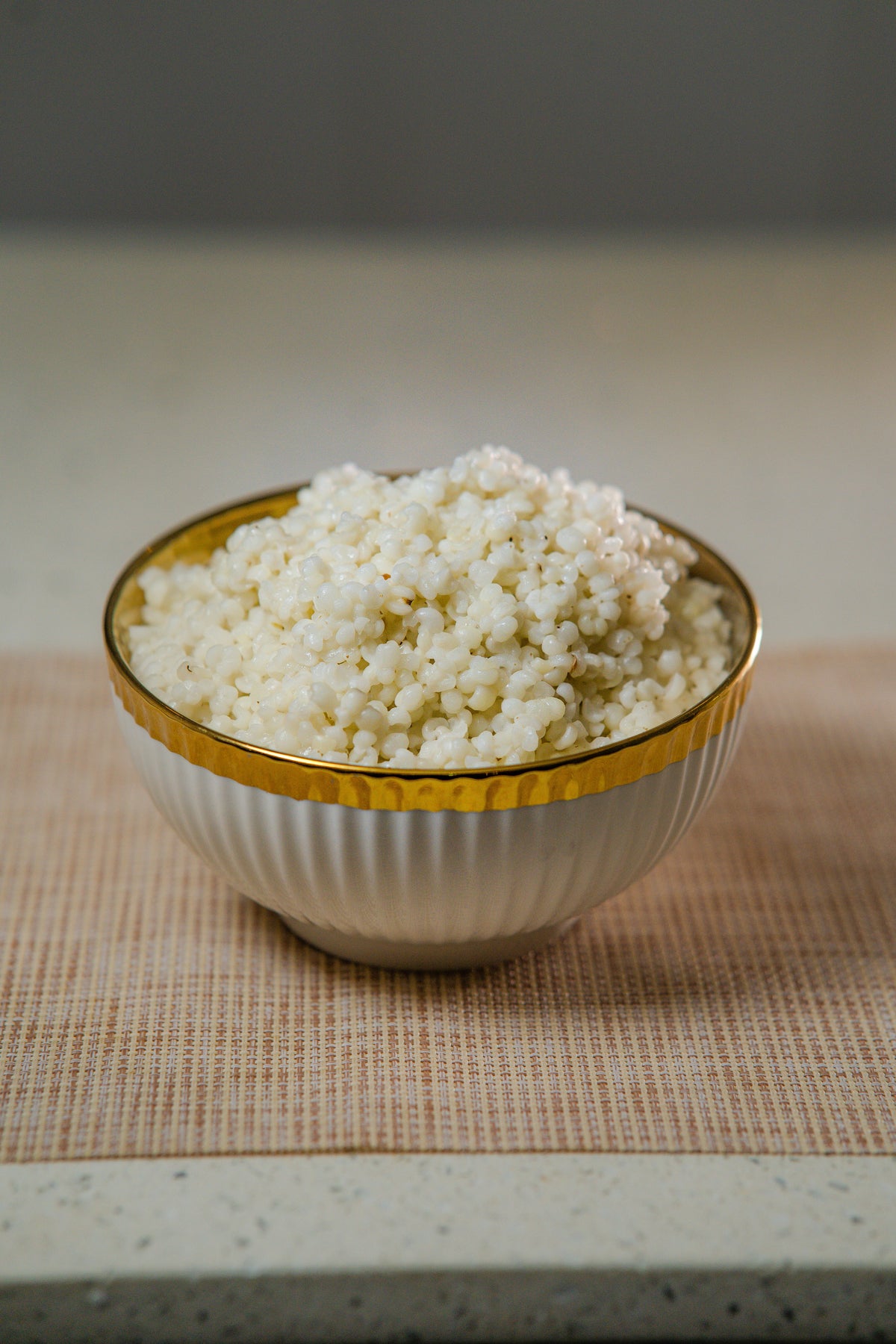
Rice is soft and immediate. It is designed to be eaten fresh and hot. Adlai remains intact. It reheats without collapsing. It works hot, warm, or cold. It holds its structure in sauces and stews.
That single characteristic turns it from a side dish into a weekly foundation. For the everyday method, see the step-by-step guide to cooking adlai.
Adlai remains intact. It reheats without collapsing. That single characteristic turns it from a side dish into a weekly foundation.
Time
White rice cooks faster, and that is part of its success. Adlai takes about twenty to twenty-five minutes. That is the entire difference.
And once cooked, adlai lasts for days. So the real comparison is not cooking time. It is cooking frequency.
12–15 minutes (best eaten fresh)
20–25 minutes (holds for 4–5 days in the fridge)
Adlai: once. Rice: daily for best results.
Sustainability is about systems, not ingredients
There are now rice farming methods — such as alternate wetting and drying — that dramatically reduce water use and methane emissions while maintaining yields. In some regions they cut irrigation demand by 30–50 percent. Those innovations are essential. They show that even the most intensive crops can evolve toward more ecological models.
The point of this comparison is not that one grain is virtuous and the other is not. It is that they come from different agricultural histories. One from a system built to feed the world as quickly as possible. The other from a system that never stopped growing at its original pace.
Which one belongs in a modern kitchen?
- speed matters
- a cuisine depends on it
- you want lightness and immediacy
- you want a higher-protein staple
- you cook for the week
- you want steady energy rather than a quick rise and fall
- you want a grain that carries the meal instead of sitting under it
For many kitchens, the answer is not replacement, it is rhythm. Rice for certain dishes, adlai for daily life.
A different category of grain
Rice is one of the most efficient carbohydrate delivery systems ever created. Adlai is a nutrient-dense staple that was never redesigned for speed. That is not a substitution. That is a different category of grain.
Bottom line
Fast cook. Fast digestion. Immediate satisfaction. Designed for scale and efficiency.
Higher protein. Slower digestion. Holds for days. A grain that works for you across the week.
In a kitchen that is trying to balance nourishment, time, and real life, that difference becomes very practical very quickly.
Take the Adlai 60-Day Challenge
The real difference between these grains is not something you understand in a single meal. You feel it when it becomes part of your routine. A pot of adlai in the refrigerator means:
- breakfast is a bowl you assemble in two minutes
- lunch is already solved
- dinner doesn't start from zero
That is when it stops being "an alternative" and becomes a staple. So the most practical way to experience adlai is simple:
Keep it in the fridge.
Use it throughout the week.
We built an 8-week adlai meal plan to make that shift automatic — with:
- weekly cooking rhythms
- breakfast, lunch, and dinner templates
- direct links to delicious recipes
- batch-cooking and meal-prep flow
No reinvention.
No daily decision fatigue.
Just continuity.
Because the question is not whether adlai is different from rice.
The question is what happens when your staple grain starts working for you every day.